
SY0-701 · Security Architecture · Updated July 25, 2026
IDS vs IPS: The Difference and When to Use Each
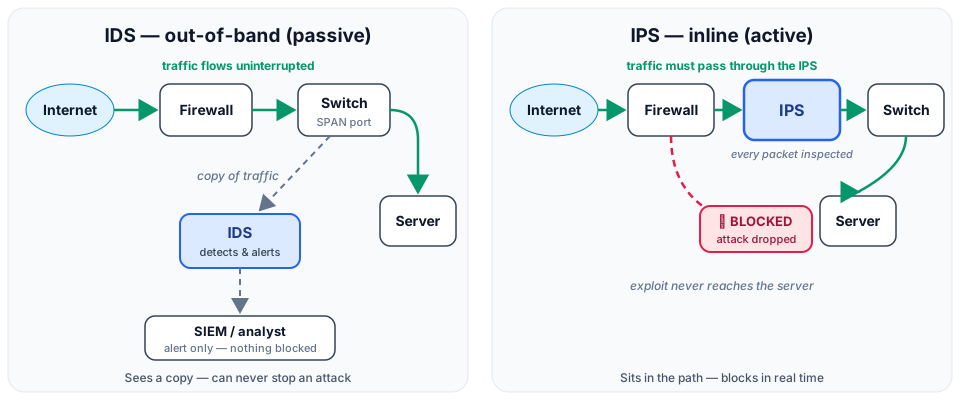
An intrusion detection system (IDS) monitors network or host activity and generates alerts when it spots something malicious, but it takes no action against the traffic itself. An intrusion prevention system (IPS) does everything an IDS does and adds one decisive capability: it sits directly in the traffic path and can drop, block, or reset malicious connections in real time. The fundamental difference is response — an IDS tells you an attack happened; an IPS stops the attack while it is happening.
What each system actually does
An IDS is a monitoring and alerting tool. It examines traffic (network-based IDS, or NIDS) or system activity (host-based IDS, or HIDS), compares what it sees against detection rules, and raises an alert when a rule fires. The alert typically lands in a security information and event management (SIEM) platform or an analyst’s queue. Because the IDS only receives a copy of traffic — usually from a switch mirror port or a network tap — the original packets have already been delivered by the time the IDS evaluates them. Nothing about the flow of traffic changes, whether the IDS is healthy, overloaded, or powered off.
An IPS uses the same detection engines, but it is deployed inline: every packet must physically pass through the device before continuing to its destination. That placement is what gives the IPS enforcement power. When a signature matches or a behavioral threshold trips, the IPS can silently drop the offending packets, terminate the session with a TCP reset, or temporarily block the source address — all before the malicious payload reaches its target. The same detect-versus-block split exists on individual endpoints, where a host-based intrusion prevention system (HIPS) blocks malicious actions on the machine itself.
The trade-off follows directly from the placement. Because an IPS touches live traffic, it adds some latency, becomes a potential point of failure, and can disrupt legitimate business traffic when a detection rule misfires. An IDS carries none of those operational risks, but it also can never stop anything on its own. For a deeper look at the deployment mechanics behind this trade-off, see inline vs passive security devices.
IDS vs IPS at a glance
| Attribute | IDS | IPS |
|---|---|---|
| Traffic position | Out-of-band (copy of traffic via SPAN port or tap) | Inline (traffic flows through the device) |
| Primary action | Detect and alert | Detect and actively block/prevent |
| Can stop an attack in progress | No | Yes |
| Latency added to traffic | None | Some (inspection happens in the forwarding path) |
| Risk if the device fails | Monitoring blind spot only | Possible network outage (unless it fails open) |
| Impact of a false positive | Wasted analyst time | Legitimate traffic blocked |
Why an IPS is not just a fancy firewall
The exam expects you to separate an IPS from a basic packet-filtering firewall, because both sit inline and both drop traffic. A traditional packet filter makes decisions from header fields alone: source and destination IP address, port number, and protocol. It has no idea what is inside the packet — a permitted port 443 connection sails through whether it carries a normal web request or an exploit payload.
A modern IPS goes far deeper. Two capabilities in particular set it apart:
- Deep packet inspection (DPI). The IPS reassembles sessions and examines the actual payload — application-layer content, file transfers, encoded commands — not just the addressing information on the outside of the packet.
- Attack-aware detection with active response. The IPS matches traffic against a continuously updated database of known exploit signatures (and often behavioral models as well), then blocks the specific malicious content in real time — even when that content rides over a port and protocol the firewall policy allows.
In short: a packet filter enforces where traffic may go; an IPS decides whether the content of that traffic is hostile. Most enterprises run both, and next-generation firewalls bundle IPS engines for exactly this reason.
Choosing between them
Deploy an IPS when the goal is prevention: stopping known exploit traffic at the internet perimeter before it ever enters the internal network, blocking malware command-and-control callbacks, or shielding an unpatched system from a known vulnerability (virtual patching). The device goes inline at a chokepoint — typically between the edge router and the internal network — so all traffic crossing that boundary is subject to enforcement.
Deploy an IDS when visibility matters more than enforcement, or when the risk of blocking legitimate traffic is unacceptable. Common cases: monitoring sensitive internal segments where an outage would be intolerable, watching east-west traffic that never crosses an inline chokepoint, and trialing new detection rules in alert-only mode before promoting them to blocking. Many organizations also run an IPS in “detection mode” first — functionally an IDS — to tune out false positives before enabling enforcement.
Both platforms rely on the same underlying detection methods, chiefly signature-based detection supplemented by anomaly-based techniques, so detection accuracy questions apply equally to either.
How the SY0-701 exam tests this
- The “block, don’t just alert” scenario. A stem describes an organization that wants to actively stop malicious traffic in real time — not merely be notified afterward. The answer is an IPS deployed inline; any option involving an IDS, a SPAN port, or passive monitoring fails the “block” requirement.
- The definitional discriminator. A straightforward question asks what fundamentally separates the two technologies. The credited answer centers on response capability: the IPS can prevent/block, the IDS can only detect/alert. Distractors claim the difference is speed, placement on hosts vs networks, or signature quality — all wrong.
- The perimeter-prevention placement. A scenario asks where and how to deploy a device so known exploit traffic never reaches the internal network. The answer combines two elements: an IPS (not IDS) positioned inline at the internet perimeter. Options that put the device on a tap or mirror port only provide detection.
- IPS vs firewall capabilities. A “choose two” question asks what a modern IPS offers that a basic packet-filtering firewall does not. Look for deep packet inspection / payload analysis and signature-based blocking of known exploits; reject answers describing ordinary port/IP filtering or network address translation (NAT).
Detect-versus-prevent appears in a dozen disguises across the exam — running SY0-701 practice questions is the quickest way to learn them all.
Quick reference
- IDS = detect and alert only; IPS = detect and actively block in real time.
- An IPS must be inline to enforce; an IDS works from a copied traffic stream and cannot stop anything.
- Inline placement means an IPS adds latency and can become an availability risk if it fails — the price of prevention.
- A basic packet-filtering firewall inspects headers (IP/port/protocol); an IPS inspects payloads with DPI and blocks known attack content.
- To stop known exploits before they enter the network, place an IPS inline at the perimeter chokepoint.
- False positives are costlier on an IPS (blocked business traffic) than on an IDS (a noisy alert queue).
- Running an IPS in alert-only mode effectively turns it into an IDS — a common tuning phase before enabling blocking.