

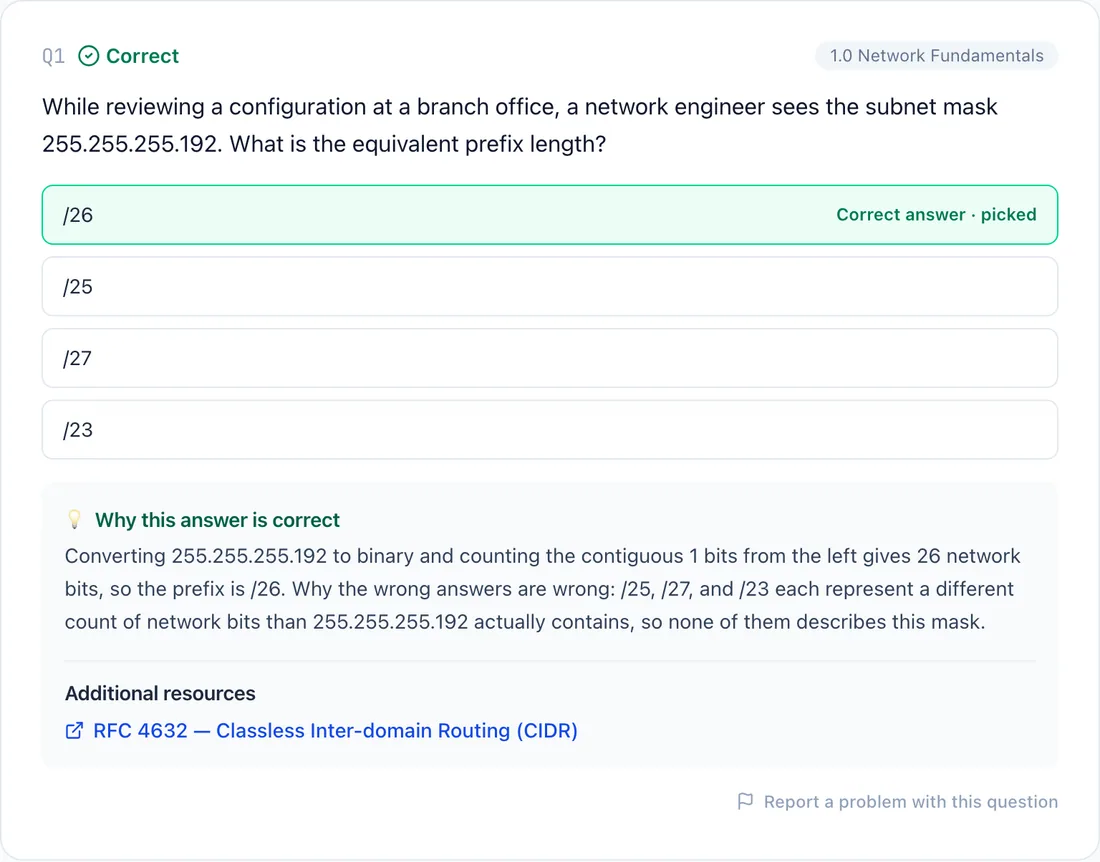
In a branch office, a Cisco IP phone connects to GigabitEthernet1/0/12 and a PC plugs into the phone's pass-through port. PC traffic must arrive in VLAN 10 and phone traffic in VLAN 110. Which interface configuration achieves this?
- A. switchport mode access / switchport access vlan 10 / switchport voice vlan 110 Correct
- B. switchport mode trunk / switchport trunk allowed vlan 10,110
- C. switchport mode access / switchport access vlan 10 / switchport trunk native vlan 110
- D. switchport mode access / switchport access vlan 110 / switchport voice vlan 10
Why A is correct
A phone-plus-PC port is configured as a normal access port for the data VLAN, then given one extra command, switchport voice vlan 110, that tells the switch to instruct the phone over CDP or LLDP to tag its voice frames with VLAN 110. The PC keeps sending untagged frames, which land in access VLAN 10.
Why the others are incorrect
Configuring switchport mode trunk with an allowed VLAN list makes the port an operational trunk, which is not how Cisco expects IP telephony ports to be built and would leave the PC's untagged traffic in the native VLAN rather than VLAN 10. Adding switchport trunk native vlan 110 to an access port has no effect, because native VLAN settings apply only when a port operates as a trunk. Assigning the access VLAN to 110 and the voice VLAN to 10 simply swaps the two, putting the PC in the voice VLAN and the phone in the data VLAN.